A corner of group relations theory, Earl Hopper’s “Fourth basic assumption” might offer a way to think about the turmoil around Brexit, as indicating an extreme anxiety arising from failed dependency

In the background is an idea from Wilfred Bion, that groups sometimes behave as if everyone has agreed to act in a particular way, but without there having been any discussion. His suggestion is that this reflects something happening at an unconscious level in the group. He coined the term “basic assumptions”, and named three common ones — that the group has become dependent on someone acting as “leader”, or has mobilised two people to work on its behalf as a conversation in a pair, or that it’s gone into a fight-flight mode. In the context of management, these ideas are useful as they can shed light on what’s going on when a group has gone from what it thinks it is trying to do, and there’s a sense of “something” getting in the way.
Earl Hopper’s fourth basic assumption
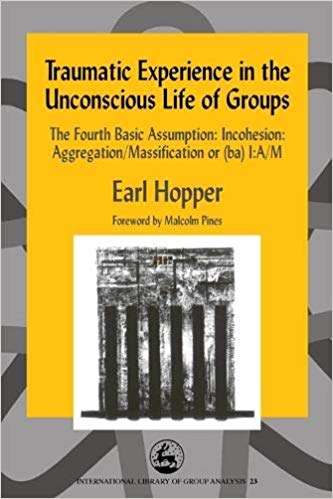
Other thinkers have observed other basic assumptions. Earl Hopper named a “fourth basic assumption”, with the moderately incomprehensible name “basic assumption incoherence, aggregation/massification” to indicate a situation where things have become very broken.
He joined together two things others had observed. One is called “basic assumption me-ness” to describe a situation where individuals feel sufficiently uncomfortable to mean they act as if the group doesn’t exist. This goes beyond “is the group trustworthy?” or “how do I find my place in the group?” to extreme withdrawl. It was first named in working with Roman Catholic monks and nuns after Vatican II: the point was that, faced with huge changes in their world, some were reacting by extreme withdrawl.
The other is “basic assumption one-ness”, describing a situation where people in the group act as if it is met for some higher transcendent purpose. Sometimes religion makes sense in these terms.
Hopper’s point was that both of these involve not engaging with the group. The sense is that the group has become an unsafe place, so people are disengaging at a very visceral level. Others have extended this to suggest this is visceral, gut-level stuff, that barely gets near conscious thought.
Continue reading “The chaos around Brexit in terms of Earl Hopper’s Fourth Basic Assumption“