Trump’s election: a bigger picture

In the closing stages of the US presidential election, Trump was describing his advance as “like Brexit but more”. That catches my sense of shock when it happened — though I wouldn’t want to take the parallel as far as he does. Shocked messages from friends in the US sound uncomfortably familiar.

donald-trump-pic

Perhaps the system will right itself. Perhaps he won’t be as bad as I fear. Perhaps he will be as bad as I fear, and be forced from office (the civil case for rape that should have been heard in December was withdrawn shortly before the election, with the claimant citing threats against her). As I write this, attempts are in progress to persuade the Electoral College not to chose him.

Continue reading “Trump’s election: a bigger picture”

Witney could be a turning point for the Lib Dems

The result in the Witney by-election was a substantial swing to the LibDems, jumping from fourth place on 6.8% to second place on 30.2%. Liz Leffman and her team did an outstanding job, and the party was clearly ready to rally to the cause.

Over the next few days there were speculations about what that would mean if replicated at a General Election, with estimates of the number of seats likely to switch from Tory to LibDem put between 26 and 51. The statistician in me is wary of those extrapolations: there are lots of unknowns at by-elections, and British politics is especially turbulent at the moment.

On the other hand, political parties usually spend a long time building up profiles of voters. Lots of volunteers flooding in at the last minute is not a good substitute for that prolonged work, so there is more to the surge in Witney than simply the number of people who came to campaign. In fact, it will be far easier to win back people who voted LibDem in 2010, now they are able to see the difference between the Tories on their own and the Tories in coalition with LibDems.

Continue reading “Witney could be a turning point for the Lib Dems”

Scapegoating of immigrants

The referendum campaign, the attitudes it unleashed, and the horrifying language reported from the 2016 Conservative Party Conference have been horrifying.

Amber Rudd: controversial speech at Tory Conference

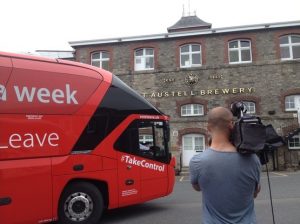
In the run-up to the referendum, on immigration immigration seemed key to the Leave campaign, who pushed in an irrational and emotional way. They correctly identified that people were sensitive to this.

There were scare stories that Turkey was about to be rushed into the EU and posters with an arrow from Turkey to the UK and the number “76 million”, strongly implying that vast numbers were queuing up to come to the UK. All that was missing was evidence.

Continue reading “Scapegoating of immigrants”

Brexit and the new class war

The 2016 Tory conference will go down as a landmark moment. I fear it will come to be seen as the signalling of a chilling new “class war”.

theresa-may2On the surface the language could be heard as optimistic, with talk of opportunity and investment and everyone benefitting, and “Hard Brexit” being tough but good.

But the scarcely-concealed panic should be ringing alarm bells. Austerity abandoned, money to be borrowed for investment in housing and infrastructure. That sounds like a Keynesian reaction to an impending economic catastrophe induced by Brexit. Is that catastrophe what people voted for?

Continue reading “Brexit and the new class war”

Migrants: welcome and fear

Recently [September 2016] I was out with some Bishop’s Stortford Liberal Democrats, gathering signatures on a petition for citizens of other EU nations currently in the UK to be allowed to remain in the UK.

britain-eu-intolerance-story_647_062816095324

In a few hours we gathered just over 250 signatures on a not-that-busy street. Some were delighted to sign. Some were relieved that we were not taking the opposite position. Some said their businesses would struggle without people from other parts of the EU.

More worrying was the small minority who disagreed, loudly wanting foreigners to “go home”. A prize for confusion goes to the person who said that, and then added that she wanted to retire to France.

Then came an apparently-xenophobic attack on two Poles in Harlow and Theresa May’s assertion that curbing immigration will take priority over access to the single market in Brexit talks. She must know this is unrealistic: freedom of movement is one of the pillars of the single market and Switzerland’s access to EU programmes was curtailed after they sought to restrict migration.

Continue reading “Migrants: welcome and fear”

An election or not?

Right now (September 2016) it feels a little like an electoral phoney war. Rumours of a possible snap general election prompted the party, rightly, to do urgent selections of prospective parliamentary candidates over the summer. Will the election happen? Could a possible false alarm be helpful?

polling_station

One answer is to wait and see: a general election in October would point to a different strategy from one early in 2017, and as Liberal Democrats, we don’t have resources to invest a lot in an election that doesn’t happen.

But the appointment of a slate of Prospective Parliamentary Candidates (PPCs) and putting things in place for an election campaign is an opportunity to put forward strong party values and to engage with people who have joined recently in shock at the referendum result. If we get it right, what we do now helps to shape the national debate and strengthens our hand for whatever elections are on the horizon. Internally, this is also a chance to run meetings where PPCs (and others) speak, helping draw people together in a way that is more positive than just lamenting the referendum result.

Continue reading “An election or not?”

Reclaiming the centre ground

This morning (26 August) my eye was caught by news of a new centre-ground think tank Radix, led by Nick Tyrone and including Nick Clegg, Stephen Kinnock and Andrew Lansley. This comes a short time after the launch of another centre initiative, involving Paddy Ashdown, More United, seeking to change the centre ground in another way. These are welcome responses to the crisis we are now in.

Brexiteers beginning to discover the impossibility of their task: creating an urgent need for a sane centre progressive option.

In November I will give a paper on the fallout of the EU referendum at the conference of OPUS (Organisation for Promoting Understanding of Society) entitled “The King is dead, there is now no king”. That’s a parody of the phase “The King is dead, Long live the King” which caught the sense of a monarchy trying to quell potential instability when a king died. The thinking is that the EU has been the containing structure for much of our political and national life for a long time: in voting for Brexit, people attacked that at a very basic level, which has been reflected in the political turmoil that has followed.

The other big idea for that paper is that we are now caught up a very complex response to globalistion. Our democracies are based on the idea that people live, work, and have most of their personal circle in one constituency, so voting for a particular MP to represent them makes sense. But in a globalised world we move around much more than that and are vastly more inter-connected, so the familiar systems are not working, but it is not clear how to replace them. Ironically, the EU seems a good starting point — depending on one’s perspectives it could be seen as a supra-national democracy, or a single market with democratic oversight.

Continue reading “Reclaiming the centre ground”

A time to grieve?

Grieving is a natural process for dealing with loss. It can be painful. People often also deny reality, which lets us deal with it gradually. Ultimately grief is a healing process which enables people to process losses and move forward in a healthy way. Owning some of the griefs Liberal Democrats have experienced could be important as part of the journey ahead.

A note about the photo – it shows two Lib Dem activists, Naomi Smith and Paul Pettinger, on the right, after the Brexit result was announced. This photo has been published in media around the world; an iconic image of the shock experienced by Remain campaigners.
A note about the photo — it shows two Lib Dem activists, Naomi Smith and Paul Pettinger, on the right, after the Brexit result was announced. This photo has been published in media around the world; an iconic image of the shock experienced by Remain campaigners.

As LibDems, we’ve had a lot to grieve in the last few years. Between 2006 and 2015 each local election seemed to bring losses. Some of the compromises of the coalition were painful. The elections to the European Parliament, the General Election and the EU referendum were excruciating.

We shouldn’t let the language of ‘LibDem fightback’ disguise the fact that we have taken a pounding, even as we welcome new members.

Continue reading “A time to grieve?”

Chosen trauma and memories of the war

One of the doorstep comments staying with me from the referendum campaign is: “I’m voting Out: we haven’t beaten the Germans in two world wars to give in now”.

Trauma and celebration in World War II

The psychoanalyst Vamik Volkan talks of “chosen traumas” and “chosen glories”, as stories from the past get retold and shape collective identity.

The trouble is that how the events are remembered changes. The stories seem to be about the past, but also have a present-day purpose. At the celebrations of the bicentenary of the French Revolution, Margaret Thatcher pointed out that we had had a revolution a century earlier: she was quoting history, but also making a point about how she understood Anglo-French relations now.

My sense is that the two world wars are acting as chosen traumas — articulating a sense of the struggle — and as chosen glories, speaking of our success.

But the wars are remembered differently on the two sides of the Channel. Though things were tough, we didn’t experience invasion, fighting in our streets, occupation or brutal repression.

Continue reading “Chosen trauma and memories of the war”

A Liberal Democrat future (speech given July 2016)

It has been an astonishing few weeks: shock waves from the Brexit vote have been echoing round the world, our two largest political parties in turmoil and a string of resignations. The spotlight has been shone on wealth inequalities, racism and xenophobia in British society. As a party, we’re right to be getting things in order in case there is a snap election.

Mark Argent
Mark Argent

I campaigned for a Remain vote — both as a Liberal Democrat and in Cambridge for Europe. Remaining in the EU is profoundly important for all of us. I very much agree with Tim Farron’s comment made soon after the referendum, that we should campaign to reverse Brexit in the next election, though quite what that means will depend on whether the formal process of leaving under article 50 of the Lisbon treaty has been triggered by then.

Between the start of the year and the referendum I knocked on just over 2100 doors. Each time I have asked the Europe question. What strikes me is how many of those who said they’d vote Leave who were doing this for reasons which had nothing to do with the EU — reasons that were to do with frustrations with life or politicians. When the EU was mentioned, people knew chillingly little about it.

Continue reading “A Liberal Democrat future (speech given July 2016)

Engaging with disgruntled Leave voters

Beside the ongoing drama around Westminster, there’s an urgent task to be done among those who voted to leave the EU and are beginning to regret it. This is crucial for the country, and wise for LibDems as well.

torn_eu_flag

I’m thinking of those taken in by false “promises” — there isn’t an extra £350 million a week for the NHS, or an end to free movement of people, Brexit doesn’t mean an end to fishing quotas, and “taking back control” now sounds like a joke. They were already alienated and this is not helping.

We’re hearing stories of Brexit hitting places that voted for it: Lush moving from Poole, Forterra mothballing plants in Accrington and Claughton. Vacancies and job prospects are down. We need a more constructive response than a brutal “You voted for it”.

Continue reading “Engaging with disgruntled Leave voters”

Beware the 1930s

My mind keeps going to parallels between the worlds of Brexit and Trump and what happened in Germany in the 1930s. It’s a worrying parallel.

A demonstrator holds up a flag during a demonstration by far-right protesters in Dover
A demonstrator holds up a flag during a demonstration by far-right protesters in Dover, from “Go home, we voted Leave” on CBC Radio

At the time of the referendum on the UK’s membership of the EU, I was in Spain at the annual meeting of the Intern­ational Society for Psycho­analytic Study of Organisations. A gathering of people from across the world who are used to exploring unconscious processes was a rich context in which to explore what was going on under the surface.

By coincidence, on polling day one conference session was intended to focus on ethical dilemmas. We were shown short films on two famous psychological experiments, the Milgram experiment and the Stanford experiment which are controversial both because people were harmed, and because they shed light on how civilised people can come to behave badly. They have been used to understand what happened in the concentration camps, but are much more widely applicable than that.

The ensuing discussion seemed a little dry, as if there was something important which was being avoided. I took the microphone and made a link with some of the violence of the referendum: the murder of Jo Cox, an incident in a supermarket where someone I had seen earlier in a Vote Leave stall was shouting at a cashier planning to vote Remain, and some very aggressive comments from Leave supporters in door-knocking in the campaign. This is not to accuse Vote Leave of orchestrating violence, but it suggests something was being mobilised (which has become more obvious since then). I commented on the dark streak in Europe: along with our capacity to be civilised, there is a capacity to behave in very destructive ways. I expressed my fear that this was close to the surface in the referendum and struggled with tears as I commented on the way the EU has been set up to contain that destructive streak in the European psyche, and the fears evoked by some in the UK wanting to pull away from that. I was met with a round of applause.

Continue reading “Beware the 1930s”